Smith Machine in Garage: Complete Setup Guide for Home Gym Builders (2025)
Smith Machine in Garage: Complete Setup Guide for Home Gym Builders (2025)
A smith machine in garage setup provides guided barbell training with built-in safety catches, eliminating the need for a spotter during heavy lifts. These machines support over 50 exercises while occupying roughly 7x4 feet of floor space. This guide covers space requirements, top 2025 models, installation steps, and programming strategies for your home gym.
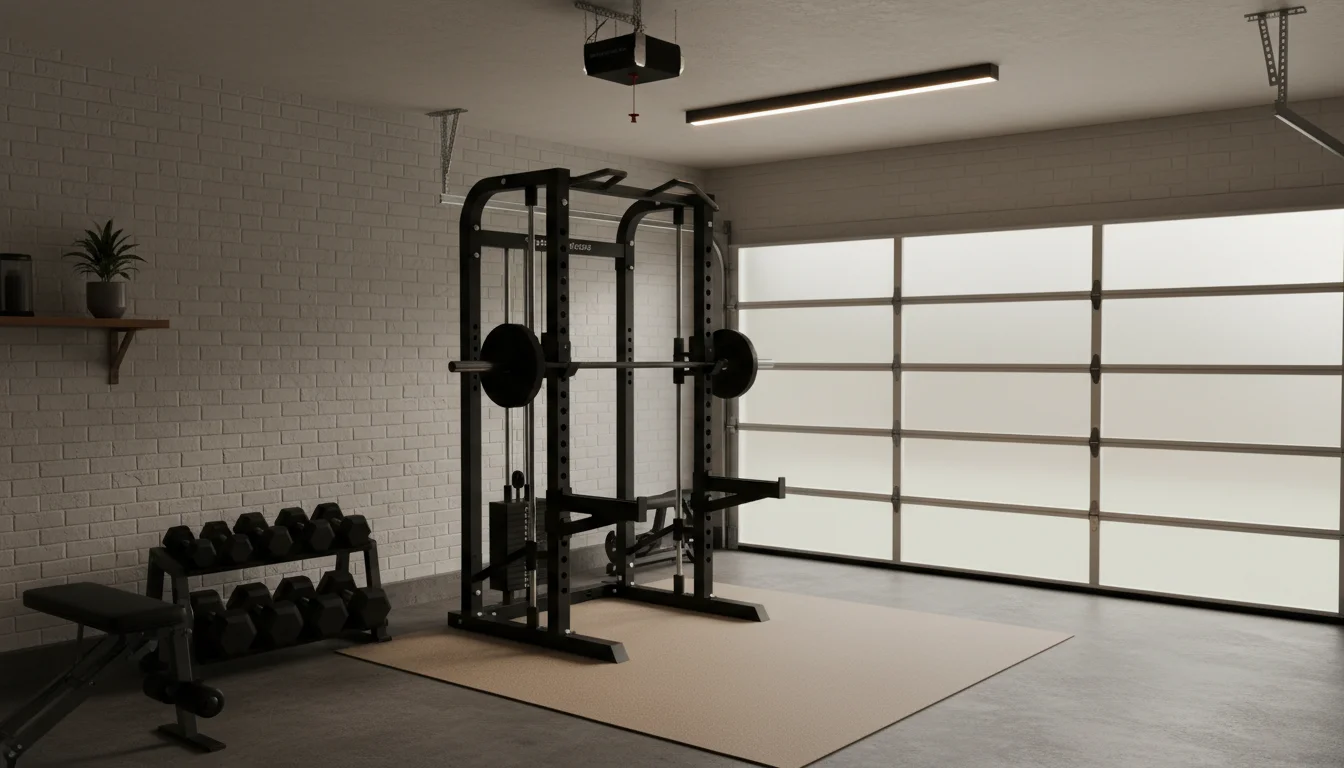
Space Requirements for a Garage Smith Machine
Plan for a total footprint of 10-11 feet wide by 7-8 feet deep to accommodate both the machine and safe movement zones.
The machine itself takes roughly 7 feet by 4 feet. You'll need 3-4 feet of clearance on each side for loading plates, performing exercises, and walking safely around the equipment.
| Requirement | Specification |
|---|
| Machine footprint | 7 ft wide × 4 ft deep |
|---|---|
| Side clearance | 3-4 ft each side |
| Total floor space | 10-11 ft × 7-8 ft |
| Standard ceiling height | 8-9 ft minimum |
| Low-ceiling models | 78-84 inches tall |
| Floor surface | Concrete with 3/4" rubber mats |
Ceiling height trips up most garage gym builders. Standard models need 8-9 feet of vertical clearance. If your garage ceiling sits at 7-7.5 feet, look for compact designs like the RitFit PSR05, built specifically for low-clearance spaces at 78 inches tall.
Concrete floors handle the weight without issue but create noise and vibration problems. Horse stall mats at 3/4-inch thickness solve both while helping level minor floor imperfections. Level floors matter more than you might expect—uneven surfaces cause binding in the guide rails, making your bar path feel sticky and inconsistent.
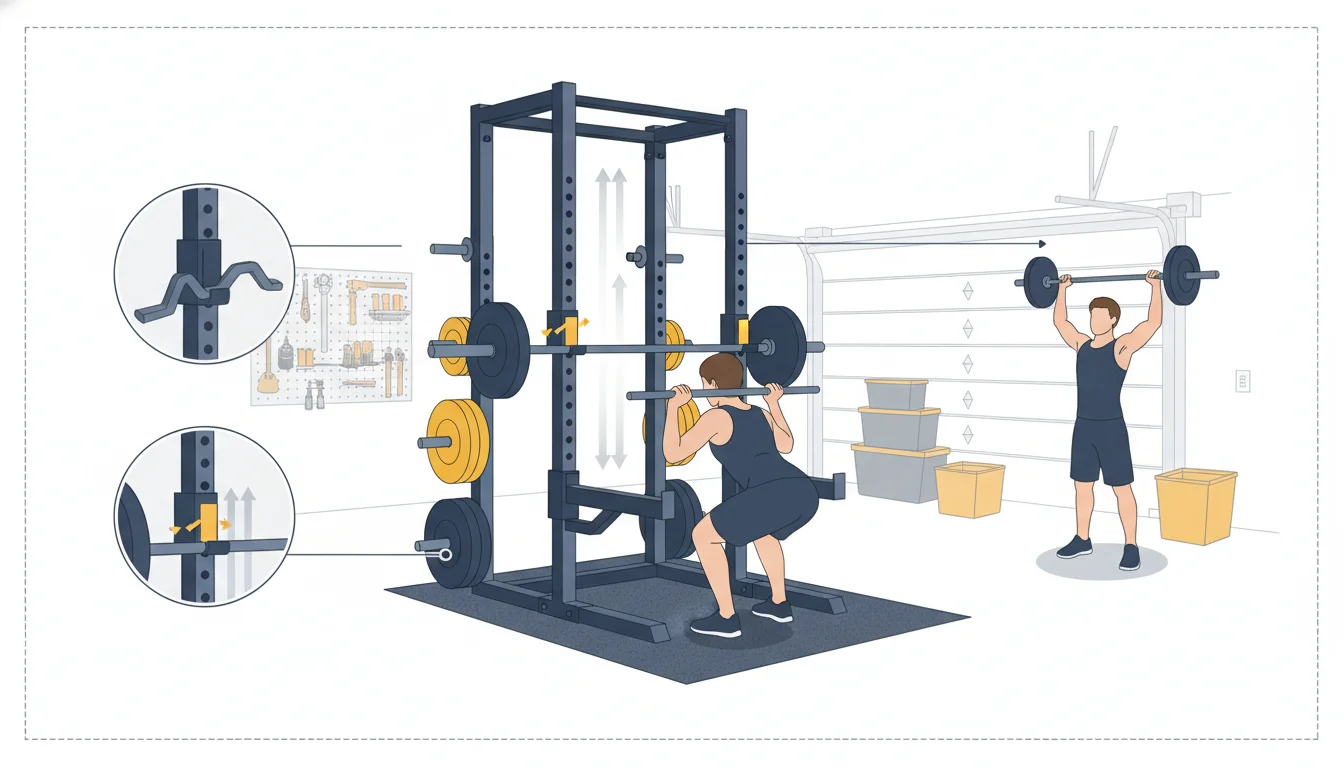
Top Smith Machine Models for Garage Gyms in 2025
Your budget determines your options, but spending more gets you smoother bar travel, higher weight capacity, and integrated cable systems.
| Category | Model | Price Range | Key Features | Best For |
|---|
| Budget | Marcy SM-4008 | Under $500 | 300 lb capacity, basic cage combo | Beginners, light training |
|---|---|---|---|---|
| Mid-Range | Titan Fitness Smith Machine | $500-$1,000 | 600 lb capacity, commercial-grade steel | Intermediate lifters |
| Mid-Range | RitFit M1 | $800-$1,200 | Cable system, low-ceiling option | Space-constrained garages |
| Premium | Bells of Steel Light Commercial | $1,500-$2,500 | 1,000 lb capacity, smooth linear bearings | Serious lifters |
| Premium | Force USA G-Series | $2,500-$4,000 | All-in-one with functional trainer | Complete home gyms |
The Marcy SM-4008 works for beginners who want to test their commitment before investing heavily. Fair warning: the 300-pound capacity limits progression quickly.
Mid-range options from Titan and RitFit hit the sweet spot for most garage gym owners. The RitFit M1 deserves special mention for garages with 8-foot ceilings—it integrates a cable system without the height penalty.
Premium all-in-one systems like the Force USA G-Series combine a smith machine, power rack, functional trainer, and cable crossover into one unit. These cost more upfront but replace $8,000+ worth of separate equipment.
Vertical versus angled bar paths matter for exercise selection. Angled paths (7-12 degrees) feel more natural for pressing movements, while vertical paths work better for strict isolation work.
Installation and Assembly Guide
Budget 3-4 hours with a helper for complete assembly. Working alone doubles that time and increases injury risk from handling heavy uprights.
Tools you'll need:- 24mm and 17mm wrenches
- Allen key set (usually included)
- Socket wrench or impact driver
- Measuring tape
- Level
1. Unbox everything and organize hardware by bag number
2. Assemble the base frame first, keeping bolts finger-tight
3. Attach vertical uprights with helper support
4. Install the smith bar and guide rails
5. Mount safety catches and j-hooks
6. Add cable system components if included
7. Tighten all bolts in sequence once aligned
8. Test bar travel before loading weight
Anchoring decisions depend on your floor and landlord situation. Concrete anchors provide the most stability but create permanent holes. A weighted base using sandbags or plate storage works well for renters.
The most common mistake: tightening bolts before checking alignment. Keep everything finger-tight until the full frame sits assembled. Then use your level, adjust as needed, and torque down in stages.
Professional assembly runs $150-$300 and makes sense for premium all-in-one units with complex cable routing. For basic smith machines, save that money for plates.
Safety Features and Considerations
Built-in safety catches and twist-lock mechanisms make smith machines inherently safer than free weights for solo lifters.
Essential safety features to verify:- Adjustable safety stops at 2-inch increments minimum
- Smooth hook catch engagement with audible click
- Linear bearings rated for your target weight
- Heavy-gauge steel frame (11-gauge or thicker)
- Stable base with anti-tip design
Set your safety stops before every exercise. Position them one inch below your lowest point in the movement. This catches failed reps without restricting range of motion.
The twist-lock mechanism lets you rack the bar at any point during a lift. Practice this motion unloaded until it becomes instinctive. A failed bench press on a smith machine means twisting your wrists and walking away. A failed bench press with free weights and no spotter means hoping you can roll the bar down your body without injury.
Teach household members two things: never walk behind someone mid-lift, and how to spot the emergency lockout position on your specific machine. Post a quick reference card near the equipment.
Weight capacity ratings include the bar, plates, and dynamic forces during lifting. A machine rated at 600 pounds safely handles a 400-pound working weight with margin for controlled failure.
Smith Machine vs Power Rack: Which Works Better for Your Garage?
Smith machines favor safety and muscle isolation. Power racks favor functional strength and athletic development. Most garage gym owners benefit more from a smith machine.
| Factor | Smith Machine | Power Rack |
|---|
| Footprint | 7×4 ft typical | 4×4 ft minimum, needs more clearance |
|---|---|---|
| Safety for solo lifting | Built-in catches, twist-lock | Requires safety arms, more attention |
| Exercise variety | 50+ exercises guided | Unlimited with free bar |
| Muscle activation | Higher isolation, lower stabilizer work | Full stabilizer engagement |
| Learning curve | Beginner-friendly | Requires form mastery |
| Cost (quality unit) | $800-$2,500 | $400-$1,500 |
The guided bar path on smith machines reduces stabilizer muscle activation by 20-40% compared to free weights. This sounds like a disadvantage until you consider the tradeoff: higher loads on target muscles with lower injury risk.
Hypertrophy-focused lifters often prefer smith machines for this reason. You can push closer to failure without the balance demands of free weights.
All-in-one systems eliminate this debate entirely. The Force USA G-Series and Bells of Steel options combine both smith and free-weight stations. You get the safety benefits for heavy work and free bar access for functional movements.
Solo lifters training heavy compound movements multiple times per week should prioritize smith machines. The accumulated safety advantage across hundreds of sessions outweighs any stabilizer muscle disadvantage.
Essential Exercises and Workout Programs
A smith machine supports a complete training program. You never need to skip a movement pattern due to equipment limitations.
Primary movements by muscle group:- Chest: Incline press, flat press, close-grip press
- Back: Bent rows, inverted rows, shrugs
- Shoulders: Overhead press, behind-neck press, upright rows
- Legs: Squats, split squats, Romanian deadlifts, calf raises
- Arms: Drag curls, skull crushers, close-grip bench
| Exercise | Sets × Reps |
|---|
| Smith squat | 4×8 |
|---|---|
| Incline press | 4×10 |
| Bent-over row | 4×10 |
| Romanian deadlift | 3×12 |
| Overhead press | 3×10 |
| Drag curl | 3×12 |
Progressive overload works the same as any program. Add 5 pounds when you complete all prescribed reps with good form. Track every session in a simple notebook or app.
The fixed bar path means foot positioning determines muscle emphasis more than with free weights. Feet forward on squats shifts load to quads. Feet back increases glute and hamstring involvement. Small adjustments create entirely different training stimuli.
FAQ
How much weight can a garage floor support for a smith machine?
Standard 4-inch residential concrete handles 300-500 PSI. A loaded smith machine with 400 pounds of plates distributes roughly 50 PSI across its base. Your floor will handle it without reinforcement.
Do smith machines work for powerlifting training?
Smith machines build muscle and strength but don't translate directly to competition lifts. The fixed bar path differs from free barbell mechanics. Use them for accessory work, not primary competition prep.
How loud is a smith machine in a residential garage?
Controlled lifting creates minimal noise. Dropped weights or metal-on-metal contact from safety catches generates significant sound. Rubber mats and controlled negatives keep neighbors happy.
Can I bolt a smith machine to my garage floor?
Yes, using concrete anchors rated for shear loads. Drill through the machine's base plate holes, insert wedge anchors, and torque to specification. This eliminates any rocking during heavy lifts.
What maintenance does a garage smith machine need?
Wipe guide rails monthly with a dry cloth. Apply silicone-based lubricant to linear bearings every 3 months. Check bolt tightness quarterly. Inspect cables for fraying if your unit includes a pulley system.
Will temperature swings in my garage affect the smith machine?
Steel frames handle temperature extremes without issue. Lubricants may thicken in cold weather, causing sticky bar travel. Switch to low-temperature silicone lubricant if your garage drops below freezing regularly.
How do I level a smith machine on an uneven garage floor?
Use rubber shims under the low corners until a bubble level shows true on both vertical uprights. Recheck after loading weight. Permanent leveling requires self-leveling concrete compound on severely uneven floors.