Power Rack vs Smith Machine: Which Is Better for Your Home Gym in 2025?
Power Rack vs Smith Machine: Which Is Better for Your Home Gym in 2025?
A power rack uses free-moving barbells requiring full-body stabilization, while a Smith machine guides the bar along a fixed vertical track. Studies show free weight movements activate up to 43% more stabilizer muscles compared to machine-guided exercises. This guide breaks down safety features, exercise versatility, space requirements, and cost to help you choose the right equipment for your training goals.
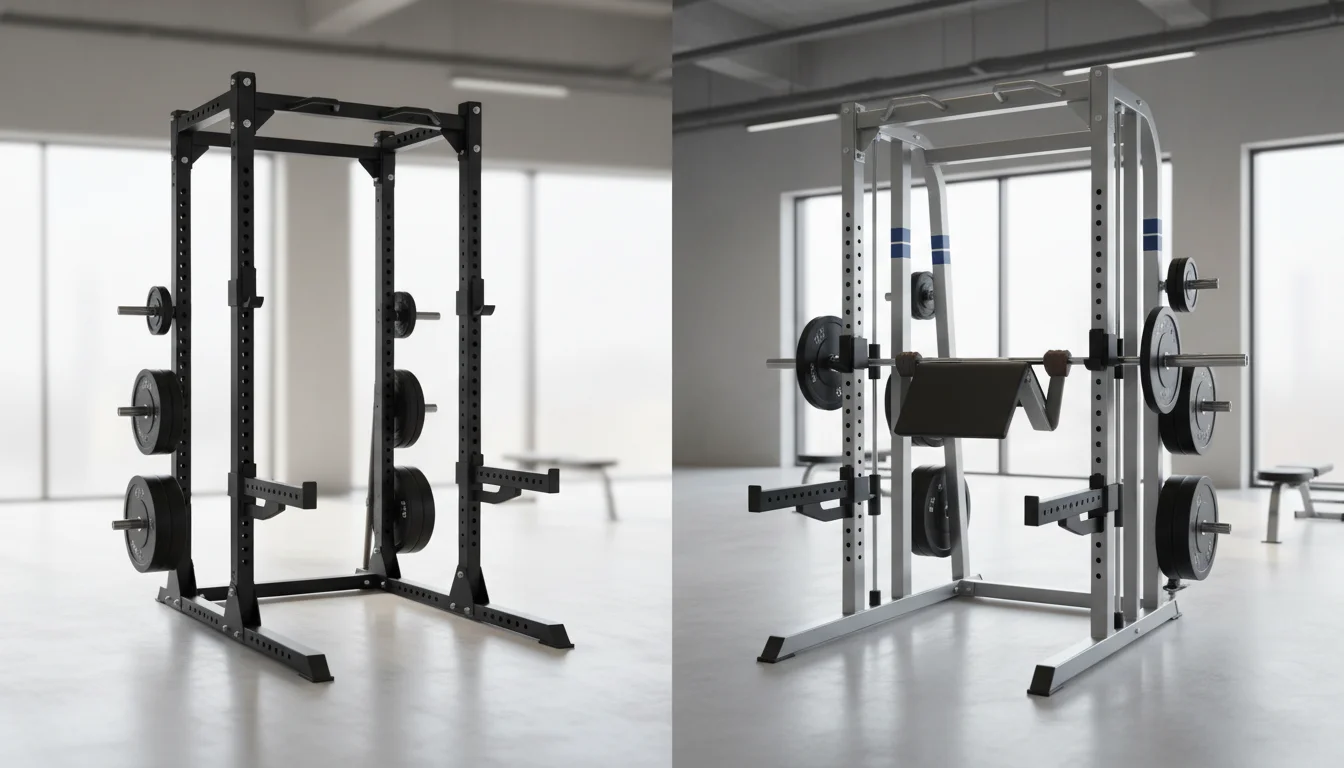
Understanding the Key Differences: Fixed Bar Path vs Free Weight Movement
The fundamental distinction comes down to movement freedom. Smith machines lock your barbell into a vertical track, handling all lateral stability for you. Power racks let the bar move in any direction, forcing your body to control the weight through space.
| Feature | Power Rack | Smith Machine |
|---|
| Bar Movement | Free 3D motion | Fixed vertical only |
|---|---|---|
| Stabilizer Activation | High | Minimal |
| Natural Bar Path | Follows body mechanics | Forces straight line |
| Balance Required | Full engagement | Machine-assisted |
| Learning Curve | Steeper | Gentler |
This difference matters more than most people realize. Your body doesn't move in perfectly straight lines during squats or presses. The bar naturally travels in a slight arc based on your limb lengths and joint angles.
When a Smith machine forces you into a rigid vertical path, your joints compensate. Some lifters develop knee or shoulder issues from years of fighting their natural movement patterns. [Major Fitness] notes that while the fixed path offers safety benefits, it restricts the natural biomechanics of lifts.
I spent my first year training exclusively on a Smith machine. Switching to free weights felt like learning to squat all over again. My stabilizers were undertrained, and my balance was poor. Starting with free weights from day one would have saved months of readjustment.
Safety Features and Self-Spotting Capabilities
Both equipment types let you train heavy without a spotter, but they accomplish this differently. Smith machines win on simplicity—twist your wrists at any point during a lift, and the bar locks onto the nearest hook. No setup required, no planning needed.
Power racks demand more preparation. You set safety pins or straps at the appropriate height before lifting. If you fail, the bar drops onto these catches. The system works well, but you need to position everything correctly beforehand.
| Safety Aspect | Smith Machine | Power Rack |
|---|
| Mid-Lift Bailout | Instant wrist rotation | Must lower to pins |
|---|---|---|
| Setup Required | None | Pin height adjustment |
| Beginner Friendliness | Excellent | Moderate |
| Failure Recovery | Re-rack anywhere | Controlled descent needed |
| Spotter Necessity | Rarely needed | Helpful for max attempts |
For solo training, the Smith machine provides a lower-stress environment. [My Arsenal Strength] points out that the instant lockout hooks give beginners confidence to push harder without fear of getting trapped under the bar.
Power rack safety pins require practice. Set them too low, and you'll have too far to fall during a failed squat. Set them too high, and they'll interfere with your range of motion. I've seen lifters skip pin setup entirely because it felt tedious—a mistake waiting to happen.
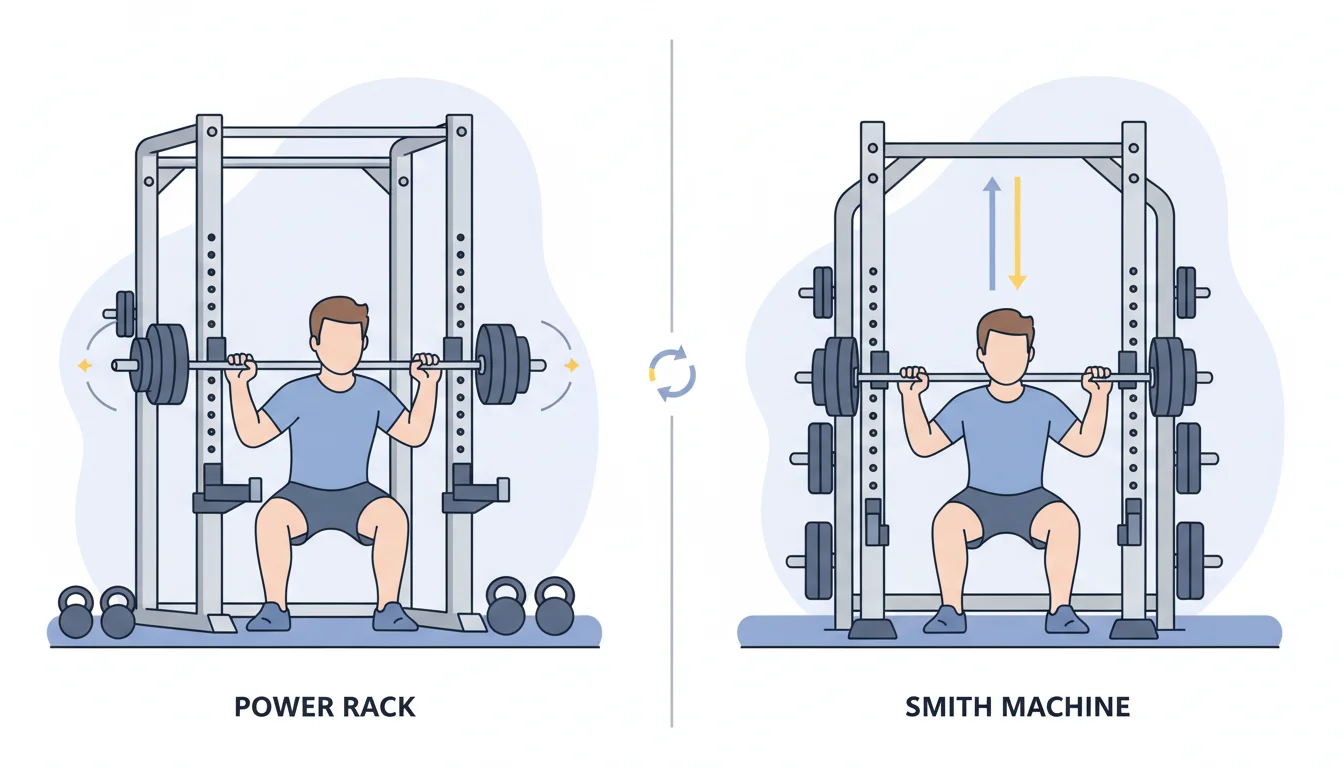
Exercise Versatility: What Can You Do With Each?
Power racks support nearly every barbell movement in existence. Smith machines handle a narrower selection, and even those exercises feel different due to the fixed path.
Power Rack Exercise List:- Back squats and front squats with natural bar path
- Flat, incline, and decline bench press
- Standing and seated overhead press
- Barbell rows in any stance
- Pull-ups and chin-ups on the crossbar
- Rack pulls and pin squats
- Dips with attachment bars
- Controlled squats with reduced balance demands
- Behind-the-back shrugs
- Calf raises with stable positioning
- Hip thrusts without bar rollout
- Inverted rows at various angles
- Close-grip bench variations
The attachment ecosystem separates these two categories further. Power racks accept lat pulldown stations, cable pulley systems, dip handles, landmine attachments, and dozens of other add-ons. Your rack grows with your training needs.
Smith machines offer fewer expansion options. The fixed bar is the main feature, and most accessories work around that limitation rather than expanding capabilities.
Gym Mikolo confirms that power racks provide the versatility favored by advanced lifters and those training functional strength through natural movement patterns.Beginner vs Advanced: Which Suits Your Fitness Level?
Beginners often gravitate toward Smith machines because the learning curve feels gentler. You focus on pushing and pulling without worrying about bar drift or balance. There's merit to this approach for building initial confidence.
The counterargument carries weight, though. Learning proper stabilization from the start builds better movement patterns. Transitioning from Smith to free weights later means relearning exercises you thought you'd mastered.
| Training Level | Best Choice | Reasoning |
|---|
| Complete Beginner | Either works | Smith builds confidence, rack builds fundamentals |
|---|---|---|
| Intermediate | Power Rack | Ready to develop full-body stability |
| Advanced/Powerlifter | Power Rack | Free weights required for competition prep |
| Post-Injury Rehab | Smith Machine | Controlled movement reduces reinjury risk |
| Bodybuilding Focus | Both valuable | Smith isolates, rack builds mass |
Rehabilitation scenarios genuinely favor Smith machines. When recovering from injury, removing balance demands lets you load healing tissues progressively. Physical therapists frequently recommend machine-guided movements during recovery phases.
My advice for true beginners: start with lighter weights on the power rack. Yes, it's harder. Yes, the bar will wobble. But you'll build a foundation that serves you for decades rather than habits you'll need to unlearn.
Space Requirements and Home Gym Setup Considerations
Measure your space before shopping. Both equipment types have minimum clearances that catch people off guard.
Typical Dimensions:- Compact power racks: 48" wide × 48" deep × 82" tall
- Full-size power racks: 62" wide × 58" deep × 92" tall
- Smith machines: 54" wide × 72" deep × 85" tall
Ceiling height creates the biggest constraint. Standard 8-foot ceilings work for most compact racks. Full-size cages with pull-up bars need 9 feet or modifications. Smith machines require clearance above the highest bar position plus your standing height.
| Space Factor | Power Rack | Smith Machine |
|---|
| Floor Footprint | Variable, 16-36 sq ft | Fixed, 27-35 sq ft |
|---|---|---|
| Ceiling Minimum | 7-8 feet | 8-9 feet |
| Depth Clearance | Moderate | Deeper for bar travel |
| Storage Options | Plate pegs built-in | Varies by model |
Garage gyms face temperature and humidity concerns. Both equipment types handle these conditions well, though cheaper powder coatings may rust in humid climates. Basement setups work great, but verify ceiling heights before ordering.
Plate storage adds to your footprint. Power racks often include weight horn attachments that keep plates organized within the rack's silhouette. Smith machines with built-in weight stacks eliminate plate clutter entirely but limit your maximum load.
Cost Analysis and Long-Term Value Comparison
Entry-level power racks start around $300. Budget Smith machines run $500-800. Quality jumps significantly in the $800-1500 range for both categories.
| Price Tier | Power Rack | Smith Machine |
|---|
| Budget | $300-500 | $500-800 |
|---|---|---|
| Mid-Range | $600-1200 | $900-1800 |
| Premium | $1500-3500 | $2000-5000 |
Here's what those prices miss: power racks need barbells and plates. A decent Olympic bar runs $200-400. Bumper plates cost $1.50-3.00 per pound. Outfitting a rack with 300 pounds adds $500-900 to your total investment.
Some Smith machines include integrated weight stacks, eliminating separate plate purchases. The all-in-one convenience justifies higher upfront costs for some buyers.
Long-term durability favors power racks. Simple steel construction with minimal moving parts means less wear. Smith machine guide rods, bearings, and cables eventually need replacement or maintenance.
Calculate your cost-per-session over 10 years. A $1500 total investment across 500 workouts equals $3 per session. Compare that to gym memberships averaging $50 monthly, and home equipment pays for itself within 30 months.
Making Your Decision: A Framework Based on Your Goals
Your training goals should drive this choice—not marketing or gym culture opinions.
Choose a Power Rack if you:- Want maximum exercise variety from one piece of equipment
- Train for strength sports or general athleticism
- Plan to progress to heavy compound lifts
- Value functional strength that transfers to real life
- Have space for storing separate plates and bars
- Train alone and prioritize quick bail-out safety
- Focus on bodybuilding with targeted muscle isolation
- Are recovering from injury and need controlled movement
- Prefer all-in-one simplicity over modular systems
- Feel intimidated by free weight balance demands
Some home gyms include both. If budget and space allow, this combination covers every training scenario. Use the rack for main compound work and the Smith for accessory isolation or days when you're training without full energy.
For pure strength development, the power rack wins. For controlled hypertrophy work and safer solo sessions, Smith machines hold genuine advantages. Neither choice is wrong if it matches your specific situation.
FAQ
Does a Smith machine build less muscle than free weights?
Smith machines build muscle effectively for targeted hypertrophy. Research shows comparable muscle activation in prime movers between both modalities. The difference appears in stabilizer development and functional strength carryover to real-world movements.
How much ceiling height do I need for a power rack?
Standard power racks require 7-8 feet minimum. Add your height plus 6 inches if you plan to do pull-ups inside the rack. Full cages with mounted pull-up bars need 9+ feet for comfortable overhead clearance during standing movements.
Are Smith machine squats bad for your knees?
The fixed path forces your knees to track in a predetermined line regardless of your anatomy. Some lifters experience no issues, while others develop knee pain over time. Adjusting your foot position forward can reduce joint stress.
Should beginners start with a Smith machine or power rack?
Both work for beginners, with different tradeoffs. Smith machines build confidence faster through stability assistance. Power racks develop better movement patterns and stabilizer strength from the start, creating a stronger foundation for long-term progress.
What attachments should I prioritize for a power rack?
Start with J-hooks and safety pins or straps. Add dip bars next for upper body variety. Lat pulldown attachments provide back training options. Landmine posts enable rotational movements. Each addition expands your exercise library significantly.
Is a Smith machine safer than a power rack for home gyms?
For instant bail-out capability during solo training, Smith machines offer simpler safety. Power racks with properly set pins provide equivalent protection but require correct setup. Both prevent serious injury when used as designed.
What's the minimum space needed for a home power rack?
Plan for 7 feet by 7 feet minimum, including room to load plates and perform movements outside the rack. Compact half-racks need less depth. Always measure your specific model's footprint plus 3 feet of clearance on each working side.