Is the Smith Machine Good for Beginners? A Complete 2025 Guide
Is the Smith Machine Good for Beginners? A Complete 2025 Guide
A Smith machine is a barbell fixed to vertical guide rails with built-in safety catches. Research shows beginners lift 10-15% heavier loads on Smith machines compared to free weights due to reduced stability demands. This guide covers mechanics, exercises, and when to transition to free weights.
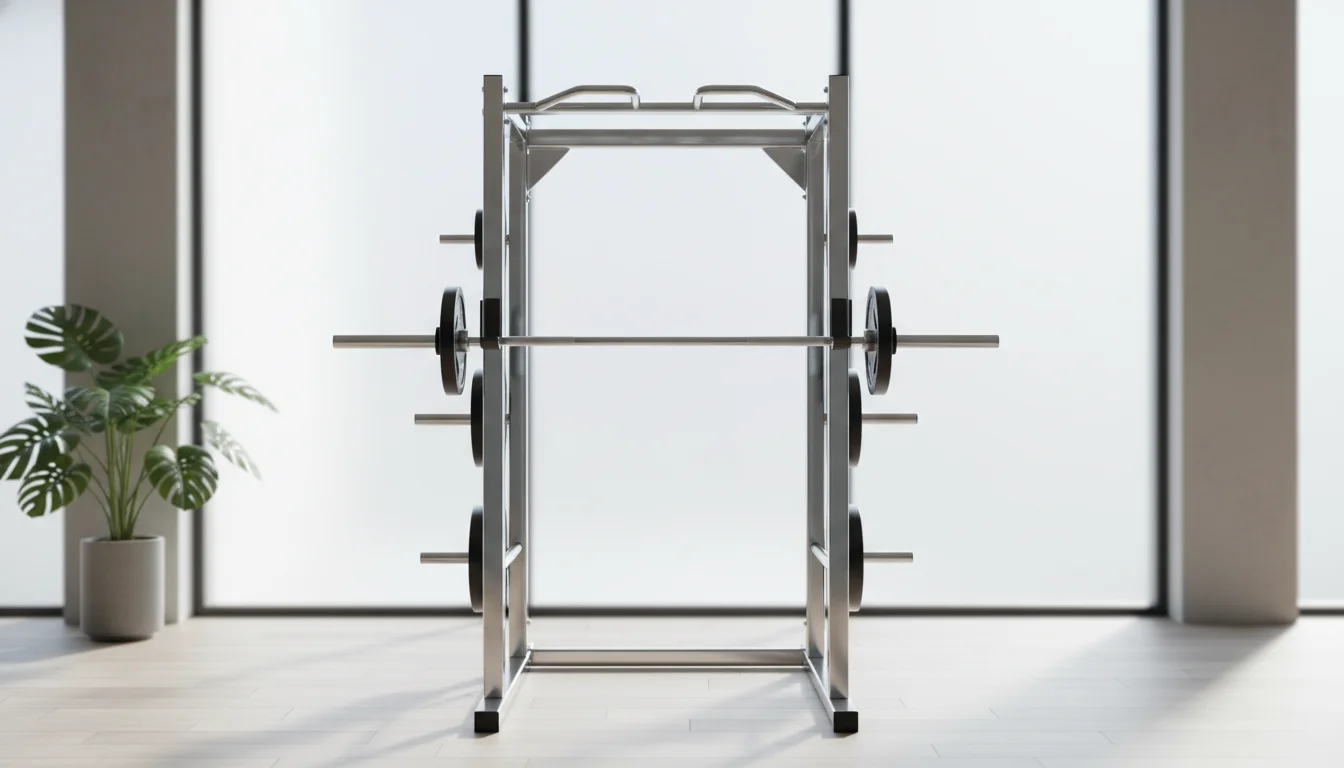
What Is a Smith Machine and How Does It Work?
The barbell travels on steel guide rails in a fixed vertical path, eliminating the need to balance weight in multiple directions. Two key safety features make this equipment stand out for gym newcomers.
| Feature | Function | Beginner Benefit |
|---|
| J-Hooks | Lock bar at any height with a wrist rotation | Bail out safely during failed reps |
|---|---|---|
| Safety Catches | Adjustable rods prevent bar from dropping below set height | Train heavy without a spotter |
| Vertical Rails | Restrict bar to straight up-and-down movement | Focus on muscle contraction, not balance |
The wrist-rotation locking mechanism takes about two gym sessions to master. Once you learn it, you'll never worry about getting stuck under a bar again. Gym Mikolo provides detailed breakdowns of these safety mechanics.
Why the Smith Machine Is Ideal for Beginners
Is the Smith machine good for beginners? Yes. The guided bar path removes the intimidation of balancing weight while you learn proper lifting mechanics, creating a safer environment for building foundational strength.- Reduced injury risk: Fixed movement prevents the bar from drifting forward or backward during squats and presses
- No spotter required: Safety catches let you push to failure alone without risking a crushed chest or pinned neck
- Better mind-muscle connection: When balance is handled for you, you can feel the target muscle working instead of compensating with poor form
- Confidence building: Successful heavy lifts create positive associations with strength training early on
- Progressive overload made simple: Add weight in small increments without worrying about stability breaking down
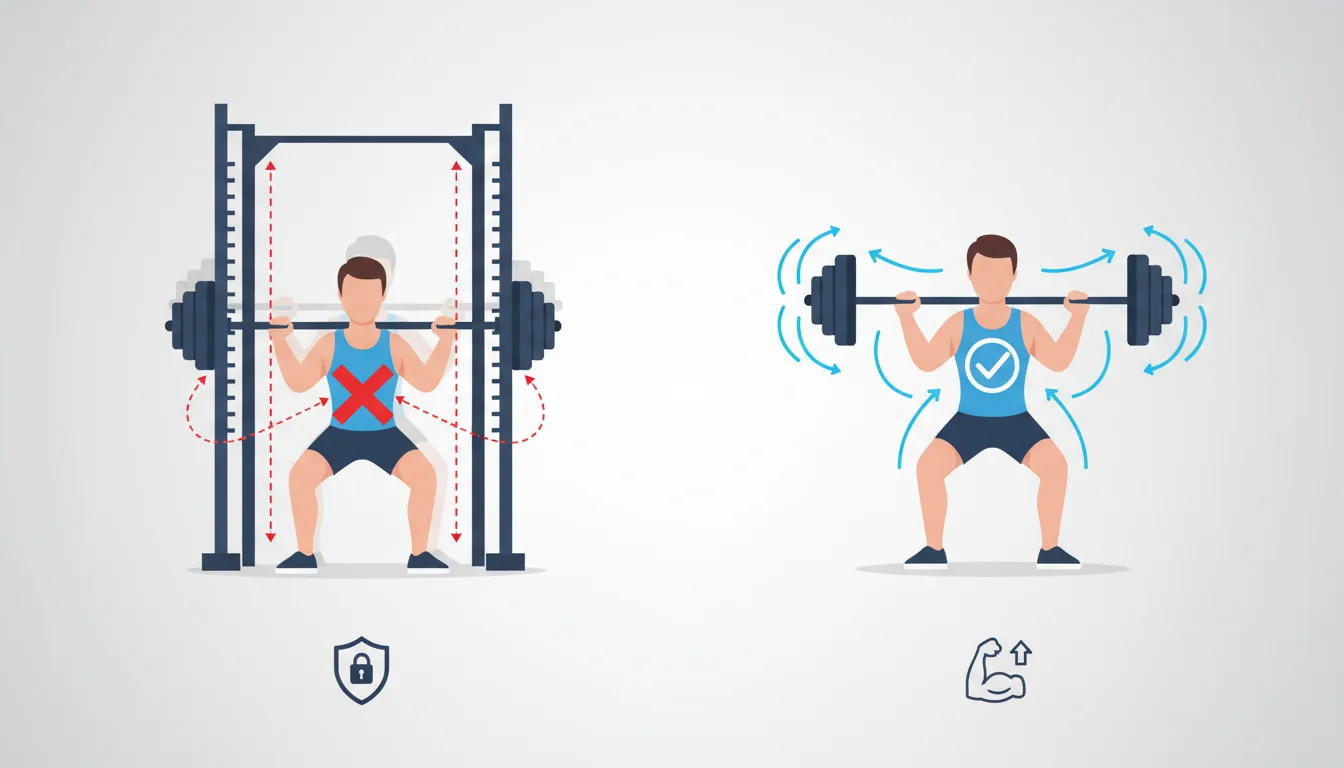
I spent my first month terrified of the squat rack. The Smith machine gave me somewhere to practice the movement pattern without that fear. Fitness Avenue notes this "removes the intimidation factor" that stops many beginners from progressing.
Best Smith Machine Exercises for Beginners
Five movements form the foundation of any beginner Smith machine workout. Each targets major muscle groups with built-in safety.
Smith Machine Squats
- Position feet 6-12 inches in front of the bar, not directly underneath
- Point toes slightly outward at 15-30 degrees
- Descend until thighs reach parallel to the floor
- Drive through heels to stand
Smith Machine Bench Press
- Lie with the bar path aligned to mid-chest
- Grip slightly wider than shoulder width
- Lower until the bar touches your chest, elbows at 45 degrees
- Press up without locking elbows completely
Smith Machine Rows
- Set the bar at mid-shin height
- Hinge forward with a flat back, knees soft
- Pull the bar to your lower chest, squeezing shoulder blades together
- Control the descent for 2-3 seconds
Shoulder Press
- Sit with your back firmly against the pad
- Start with the bar at chin level
- Press overhead without arching your lower back
Lunges
- Position the bar across your upper traps
- Step back into a lunge, front knee tracking over toes
- Both knees bend to 90 degrees at the bottom
The forward foot placement on squats feels strange at first. Trust it. This positioning keeps your spine neutral and puts the load through your quads and glutes rather than your lower back.
Smith Machine vs. Free Weights: What Beginners Should Know
The "Smith machines build bad form" argument misses important context. Both tools serve different purposes at different stages of training.
| Factor | Smith Machine | Free Weights |
|---|
| Stabilizer muscle activation | Lower | Higher |
|---|---|---|
| Injury rate for beginners | Lower | Higher |
| Learning curve | 1-2 weeks | 4-8 weeks |
| Strength transfer to daily activities | Moderate | High |
| Solo training safety | Excellent | Requires spotters for heavy lifts |
| Muscle isolation | Better | Moderate |
Stabilizer muscles matter less than you think when you're starting out. Your primary movers—chest, quads, back—need to develop basic strength before stabilizers become the limiting factor. Strength Warehouse USA recommends beginners start with guided movements, then progress.
Free weights win for long-term functional strength. The Smith machine wins for building that initial foundation safely. Use both.
Common Beginner Mistakes to Avoid on the Smith Machine
Four errors show up repeatedly with new lifters. Each reduces effectiveness or increases injury risk.
- Feet directly under the bar during squats: This forces knees too far forward and loads the joints instead of muscles. Walk your feet out 6-12 inches.
- Ego loading: The machine's stability lets you lift heavier than your muscles are ready for. Your connective tissues still need time to adapt.
- Skipping warm-up sets: Cold muscles don't fire efficiently. Do 2-3 sets at 50% of your working weight before loading up.
- Safety catches set too low: Position them 1-2 inches below your lowest point in the movement. Test with an empty bar first.
The ego loading trap catches everyone. I added 40 pounds to my squat in two weeks because the machine made it feel easy. My knees disagreed loudly. Build slowly.
When to Progress from Smith Machine to Free Weights
Three signs indicate readiness for the transition: consistent form, appropriate strength levels, and expanding fitness goals.
| Sign | What It Looks Like | Action |
|---|
| Form consistency | Same movement pattern for 10+ reps across multiple sets | Add one free weight exercise per week |
|---|---|---|
| Strength plateau | No progress for 2-3 weeks despite good recovery | Free weight variation may break through |
| Sport-specific goals | Training for activities requiring balance and coordination | Prioritize free weights, use Smith for isolation |
The transition works best as a gradual blend rather than a hard switch. Start with dumbbell variations of movements you've mastered on the Smith machine. Keep the Smith machine for heavy compound lifts while your stabilizers catch up. Fitness Town recommends 4-8 weeks of Smith machine work before introducing barbell movements.
FAQ
How much weight should a beginner start with on the Smith machine?
Start with just the bar, which weighs 15-25 pounds depending on the model. Add 5-10 pounds per session until form breaks down, then stay at that weight for a week.
Does the Smith machine bar weight count in your total lift?
Yes, include it. Most commercial gym Smith machine bars weigh 15-20 pounds. Check with gym staff or weigh it yourself for accurate tracking.
Can you build muscle effectively with only a Smith machine?
Absolutely. Muscle growth responds to progressive tension, not equipment type. Many bodybuilders use Smith machines for targeted hypertrophy work throughout their careers.
Is the Smith machine bad for your knees?
Not when used correctly. Proper foot placement protects knee joints. The fixed path becomes problematic only when your body positioning fights against it.
How often should beginners use the Smith machine?
Two to three sessions per week with 48 hours between sessions targeting the same muscle groups. This allows adequate recovery for muscle and connective tissue adaptation.
Why do some trainers say Smith machines are useless?
This view prioritizes athletic performance and functional strength over general fitness. For those goals, free weights offer better transfer. For beginners building basic strength, the Smith machine serves an important purpose.
Should I use the Smith machine for deadlifts?
Conventional deadlifts work poorly on the Smith machine due to the fixed bar path. Use it for Romanian deadlifts instead, which follow a more vertical pattern naturally.