Is Smith Machine Shoulder Press Good? Benefits, Drawbacks & Expert Analysis (2025)
Is Smith Machine Shoulder Press Good? Benefits, Drawbacks & Expert Analysis (2025)
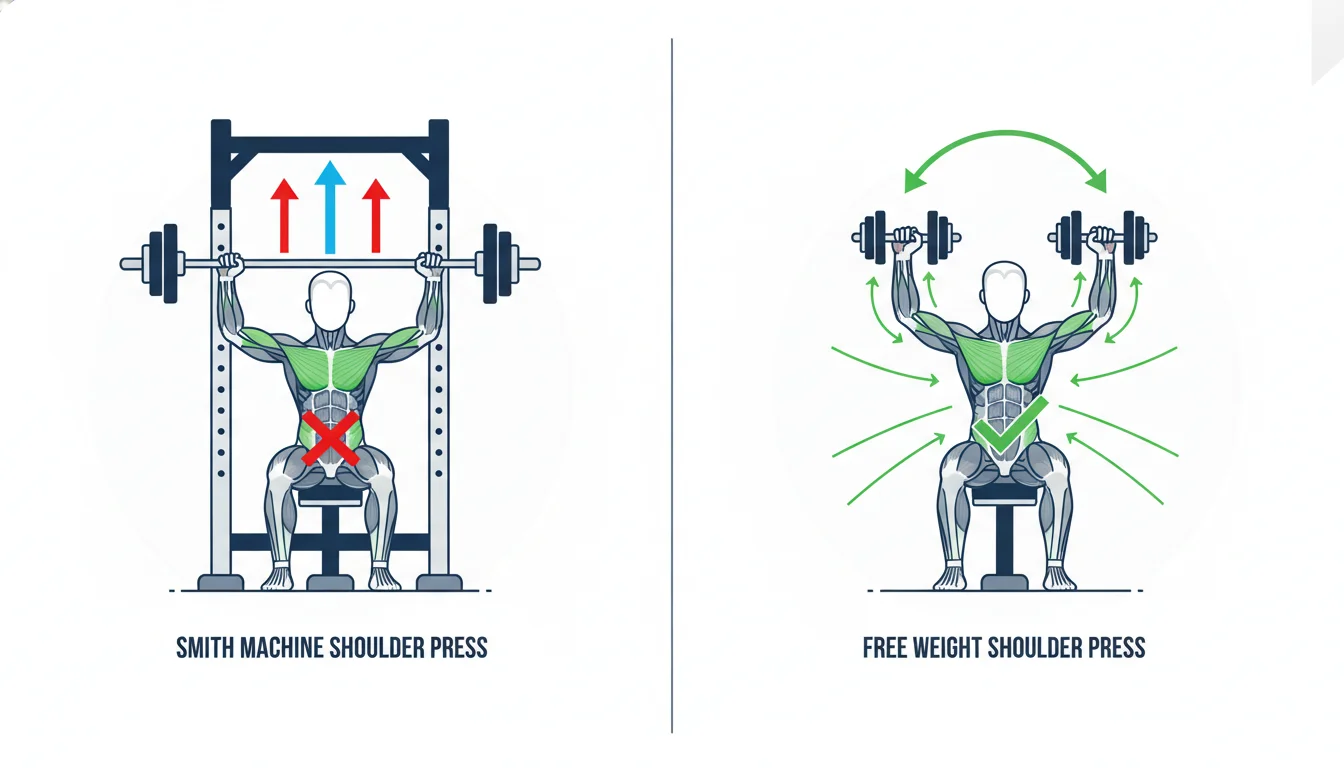
The Smith machine shoulder press is a compound upper-body exercise performed on a barbell fixed to vertical or angled rails. Studies show similar primary muscle activation between Smith machine and free-weight pressing, though the machine reduces stabilizer muscle engagement by approximately 30-40%. This guide covers the benefits, drawbacks, proper form, and programming to help you decide if this exercise belongs in your routine.
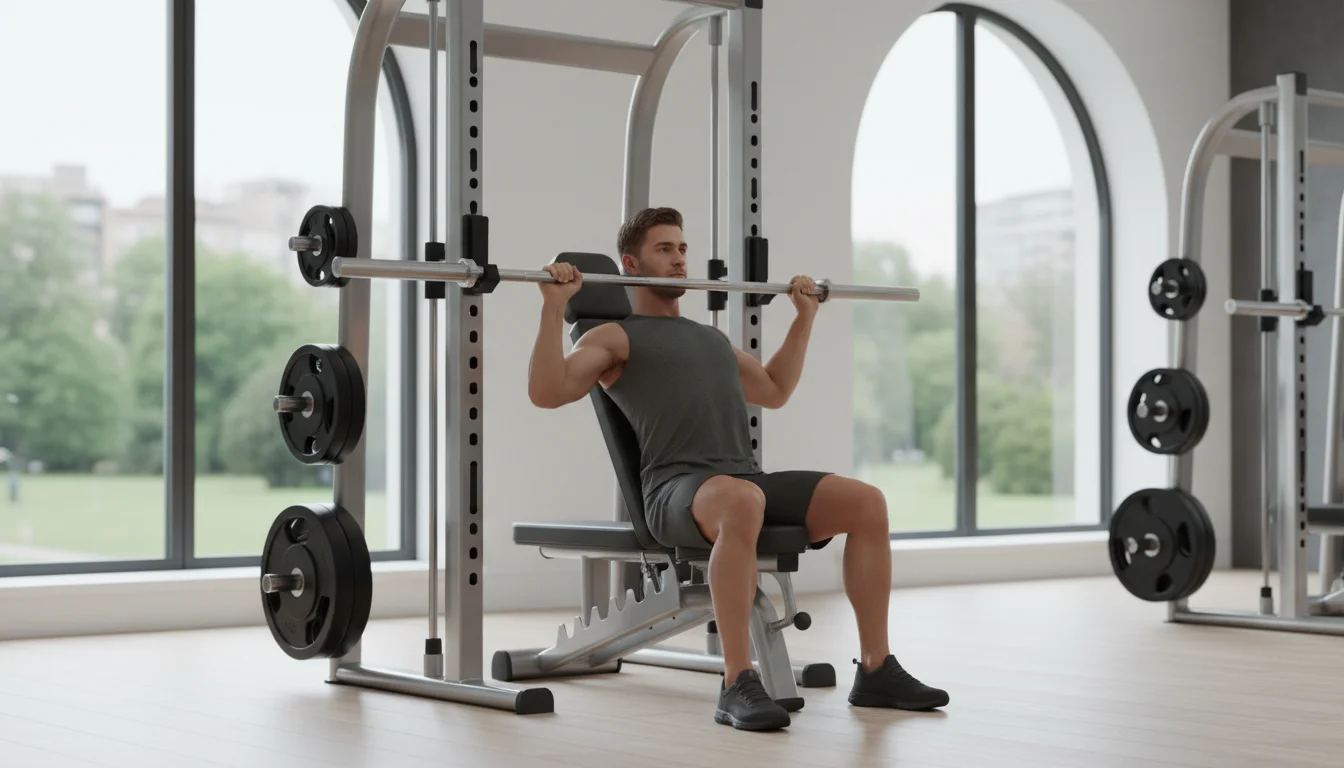
What Is the Smith Machine Shoulder Press?
This exercise uses a barbell attached to guide rails that control the bar's path during overhead pressing movements. The apparatus allows vertical movement only, creating a controlled pressing environment that differs significantly from free-weight alternatives.
Primary muscles worked:| Muscle Group | Role | Activation Level |
|---|
| Anterior Deltoids | Primary mover | High |
|---|---|---|
| Lateral Deltoids | Primary mover | High |
| Triceps | Elbow extension | Moderate-High |
| Upper Chest | Assistance | Moderate |
| Trapezius | Scapular stability | Low-Moderate |
The seated variation positions a bench with back support inside the machine, increasing shoulder isolation by removing lower body involvement. Standing versions require more core engagement but often feel awkward given the fixed bar path.
Most lifters prefer seated. The back support lets you focus entirely on pressing without worrying about balance.
Benefits of Smith Machine Shoulder Press
Is smith machine shoulder press good for building shoulder muscle? The answer depends on your goals, experience level, and training context. For isolation and safety, this exercise delivers serious advantages over free weights. Key benefits:- Built-in safety catches allow training to failure without a spotter. The bar locks at any point during the lift with a simple wrist rotation.
- Enhanced muscle isolation targets deltoids directly since stabilizer muscles handle less work. Your shoulders take the full load.
- Beginner-friendly mechanics teach proper pressing patterns. The guided path prevents the bar from drifting forward or backward.
- Consistent tracking makes progressive overload straightforward. You lift the same path every rep, every set, every workout.
- Injury rehabilitation tool provides controlled range of motion for those recovering from shoulder issues.
- Heavy loading potential lets you push more weight safely without fear of the bar crashing down.
I started using the Smith machine shoulder press after tweaking my rotator cuff. The fixed path let me rebuild strength without aggravating the injury. Fair warning: ego lifting is tempting here since you'll handle more weight than with dumbbells.
According to [Major Fitness], the reduced stabilizer demand allows greater overload of the deltoids, which supports hypertrophy when volume and intensity are programmed correctly.
Drawbacks and Limitations to Consider
The fixed bar path creates problems for some lifters. Your shoulders naturally press in a slight arc, not a straight vertical line. The machine forces a movement pattern that might not match your anatomy.
Main limitations:- Reduced stabilizer activation weakens rotator cuff muscles over time if Smith machine pressing is your only overhead work
- Unnatural movement path places extra stress on shoulder joints for certain body types
- Movement pattern imbalances develop when prime movers grow strong while stabilizers lag behind
- Limited functional carryover to real-world pressing or athletic movements
- False strength perception since the weight lifted doesn't transfer directly to free-weight exercises
Electromyographic research confirms lower stabilizer muscle activation on Smith machines compared to barbells and dumbbells. This matters if shoulder health and functional strength are priorities.
The fix is simple: use the Smith machine as one tool, not your only tool. Pair it with dumbbell work to maintain stabilizer strength and natural movement patterns.
Smith Machine vs Barbell vs Dumbbell Shoulder Press
Each variation serves a specific purpose. Choosing the right one depends on your training goals, experience, and physical limitations.
| Factor | Smith Machine | Barbell | Dumbbell |
|---|
| Stabilizer Activation | Low | High | Highest |
|---|---|---|---|
| Safety Without Spotter | Excellent | Poor | Good |
| Movement Path | Fixed | Semi-Fixed | Free |
| Max Load Potential | Highest | High | Moderate |
| Addresses Imbalances | No | No | Yes |
| Beginner Suitability | Excellent | Moderate | Good |
| Functional Carryover | Low | High | High |
Research from PubMed shows free weights produce greater medial deltoid activation compared to Smith machine pressing. However, primary mover activation remains similar across all three variations.
The barbell overhead press builds the most functional strength. Dumbbells address side-to-side imbalances and allow natural shoulder movement. The Smith machine isolates deltoids and enables heavy, safe loading.
Best approach? Use all three. Rotate them based on your training phase and daily goals.
Proper Form and Technique Guide
Setup determines success with this exercise. Poor positioning creates shoulder discomfort and limits muscle activation.
Step-by-step execution:1. Position the bench so the bar travels directly over your shoulders at the bottom position
2. Set bar height at upper chest or chin level when seated
3. Grip the bar slightly wider than shoulder-width with palms facing forward
4. Unrack the bar by rotating your wrists to release the safety hooks
5. Lower with control until the bar reaches chin or upper chest level
6. Press explosively while keeping your core tight and back against the pad
7. Squeeze at the top without fully locking your elbows
Common mistakes to avoid:- Flaring elbows out at 90 degrees. Keep them at 45-75 degrees to protect your shoulders.
- Excessive lower back arch. Press your back flat against the bench throughout.
- Incomplete range of motion. Go deep enough to feel a stretch in your front delts.
- Bouncing at the bottom. Control the negative and pause briefly before pressing.
Breathe in as the bar descends. Exhale forcefully as you press up. This breathing pattern stabilizes your core and protects your spine.
Seated beats standing for shoulder isolation. The back support removes momentum and cheating from the equation.
Programming Recommendations for Different Goals
Your sets, reps, and weight selection should match your training objective. The Smith machine works for hypertrophy, strength, and endurance when programmed correctly.
| Goal | Sets | Reps | Rest Period | Weight Selection |
|---|
| Muscle Building | 3-4 | 8-12 | 60-90 sec | Moderate, 2-3 RIR |
|---|---|---|---|---|
| Strength | 4-5 | 4-6 | 2-3 min | Heavy, 1-2 RIR |
| Endurance | 2-3 | 15-20 | 30-45 sec | Light, near failure |
Train shoulder press 1-2 times weekly as part of a push or shoulder-focused session. Higher frequency risks overtraining this vulnerable joint.
Progressive overload strategies for Smith machine pressing:- Add 5 pounds when you hit the top of your rep range
- Increase sets before increasing weight for intermediates
- Slow the eccentric to 3-4 seconds for advanced progression
- Use rest-pause or drop sets when weight increases stall
The safety catches make advanced techniques like rest-pause sets practical. Push to failure, rack it, breathe for 15 seconds, and go again.
FAQ
Is the Smith machine shoulder press bad for your shoulders?
Not inherently. Problems arise from poor form or exclusive use without free-weight training. The fixed path stresses certain anatomies more than others. If you feel discomfort, adjust your bench position or switch to dumbbells.
How much weight should I start with on Smith machine shoulder press?
Start with the bar alone (typically 15-25 pounds) to learn the movement pattern. Add weight in 10-pound increments until you find a load that challenges you for 10-12 reps. Most beginners land between 50-80 pounds total.
Can Smith machine shoulder press build big shoulders?
Yes. Primary deltoid activation matches free weights in research studies. Hypertrophy depends on progressive overload, adequate volume, and proper nutrition. The Smith machine delivers sufficient stimulus when programmed with appropriate intensity.
Should I do Smith machine or dumbbell shoulder press first?
Start with the exercise that matches your primary goal. For strength and heavy loading, begin with the Smith machine while fresh. For stabilizer development and shoulder health, prioritize dumbbells. Alternate weekly for balanced development.
How far down should I lower the bar?
Lower until the bar reaches chin level or touches your upper chest. This range provides full anterior deltoid stretch without excessive shoulder stress. Going behind the neck increases injury risk and requires exceptional mobility.
Is Smith machine shoulder press good for beginners?
The Smith machine shoulder press ranks among the safest pressing options for beginners. The guided path teaches proper mechanics while safety catches prevent dangerous failures. That said, beginners should still learn free-weight pressing within their first few months of training.
Can I replace all overhead pressing with Smith machine?
Not recommended. Exclusive Smith machine use leads to stabilizer weakness and potential shoulder issues over time. Use it for 50% or less of your total pressing volume, and balance with barbell and dumbbell variations for complete shoulder development.
Why can I lift more on Smith machine than with free weights?
The machine handles stabilization that your body normally provides. Rotator cuff muscles, core, and smaller shoulder stabilizers contribute less to the lift. This extra capacity goes directly to the prime movers. Expect 10-20% higher loads compared to the standing barbell press.