How to Use the Smith Machine Correctly: A Complete Guide for All Fitness Levels (2025)
How to Use the Smith Machine Correctly: A Complete Guide for All Fitness Levels (2025)
The Smith machine is a barbell fixed within steel rails that restricts movement to a vertical or angled path, with built-in safety catches for controlled lifting. Research shows free-weight squats produce 43% higher muscle activation than Smith machine squats, yet the machine remains valuable for targeted isolation and safe progressive overload. This guide covers how to use the Smith machine correctly, including setup, form, essential exercises, and safety protocols.
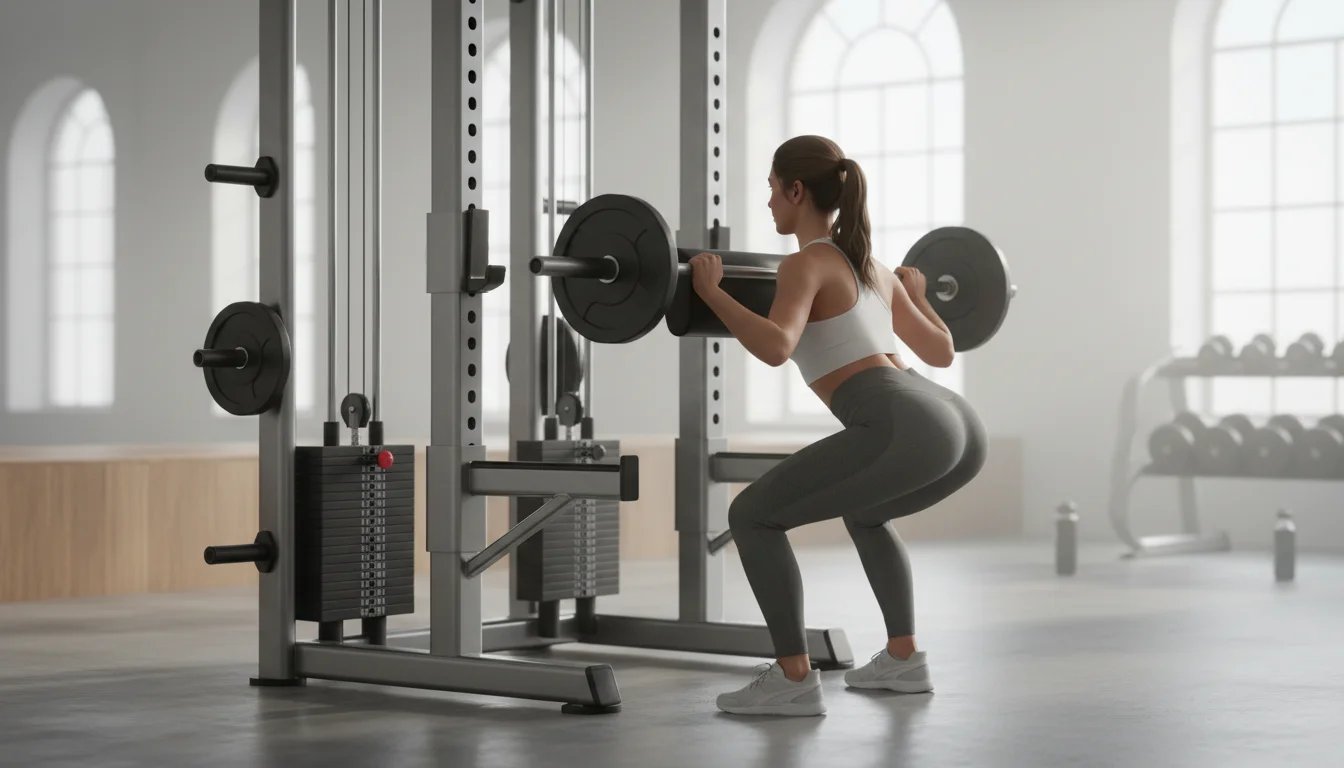
What Is a Smith Machine and How Does It Work?
A guided barbell system attaches to vertical rails via bearings, allowing smooth sliding motion while safety catches stop the bar at preset heights if you fail a lift.
The core components include:
- Barbell attached to guide rails for controlled movement
- Vertical guide rails forming the frame that restricts bar path
- Safety catches adjustable to multiple heights for injury prevention
- Hooks on the barbell that lock into stops with a simple wrist rotation
| Machine Type | Bar Path | Best For |
|---|
| Vertical track | Straight up and down | Bench press, shoulder press |
|---|---|---|
| Angled track (7-10°) | Slight backward angle | Squats, more natural movement pattern |
The fixed path eliminates the need for balance and stabilization, making the Smith machine ideal for beginners learning movement patterns, people in rehabilitation, and solo lifters training without a spotter. Fair warning: you'll need to adjust your body positioning compared to free weights since the bar won't adapt to your natural movement arc.
Essential Safety Setup Before Your First Rep
Set safety catches just above the lowest point of your intended range of motion before loading any weight onto the bar.
Here's your pre-lift checklist:
- Safety catches: Position them 1-2 inches above your deepest point (above knees for squats, above chest for bench)
- Rotation lock test: Practice twisting the bar to engage hooks on the rails—do this empty first
- Weight loading: Add plates evenly on both sides and use collars to prevent sliding
- Bar path check: Run through 3-5 empty reps to ensure the bar glides without sticking or jamming
- Body alignment: Position yourself so your natural movement follows the fixed bar path
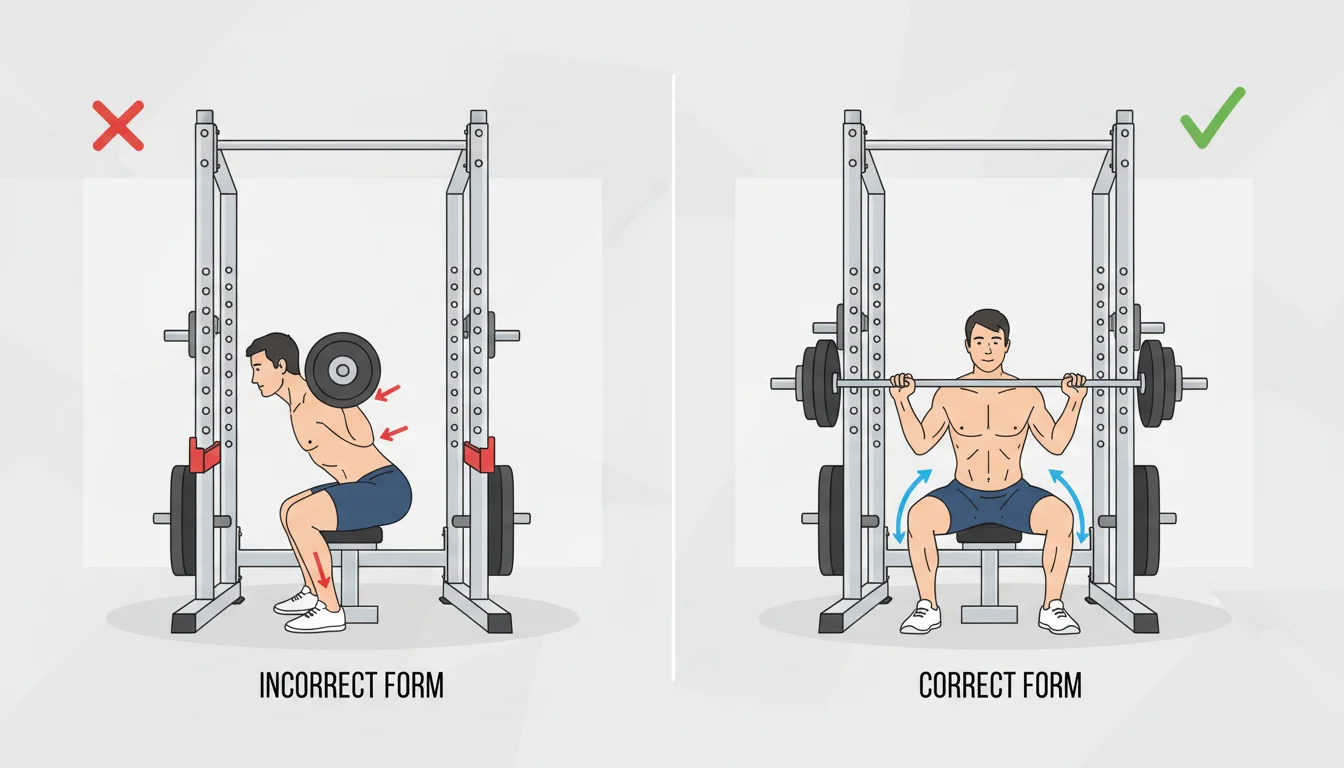
The emergency bail-out is simple: twist your wrists at any point during the lift to rotate the bar and engage the safety hooks. I practiced this 10 times before my first loaded set. Trust me, knowing you can escape builds confidence for heavier attempts.
According to Gym Mikolo, the Smith machine's adjustable safety stops make solo training significantly safer than free weights when properly configured.
Mastering Proper Body Positioning and Form
Your foot placement relative to the bar determines whether you load muscles or joints. The fixed path requires positioning adjustments that differ from free-weight technique.
Foot and grip positioning by exercise:| Exercise | Foot Position | Grip Width | Key Alignment Cue |
|---|
| Squat | 6-12 inches forward of bar | N/A | Knees track over toes |
|---|---|---|---|
| Bench Press | Flat on floor | Just wider than shoulders | Elbows at 45° angle |
| Shoulder Press | Hip-width, under hips | Slightly wider than shoulders | Wrists stacked over elbows |
| Deadlift | Hip-width, close to bar | Shoulder-width | Bar stays in contact with legs |
The biggest positioning difference from free weights: place your feet forward during squats rather than directly under the bar. This accommodates the vertical path and shifts load onto your quads and glutes instead of your lower back. Maintain a neutral spine throughout all movements. I learned this the hard way after rounding my back during heavy rows.
Step-by-Step Guide to Essential Smith Machine Exercises
Each exercise requires specific setup adjustments to maximize muscle activation while respecting the fixed bar path.
Smith Machine Squat
Stand with feet shoulder-width apart, positioned 6-12 inches in front of the bar. Rest the bar on your upper traps. Unlock and lower until your thighs reach parallel, then drive through your heels to stand.
- Depth cue: Hips should drop below knee level
- Knee tracking: Push knees outward over pinky toes
- Sets/Reps: 3-4 sets of 5-8 reps
- Tempo: 3 seconds down, 1 second pause, explosive up
Smith Machine Bench Press
Lie with your eyes directly under the bar. Retract your shoulder blades and pin them to the bench. Grip just outside shoulder width, lower to mid-chest with control, then press.
- Bar path: Straight down to nipple line
- Arch: Natural lower back curve, not excessive
- Sets/Reps: 3 sets of 8-12 reps
- Tempo: 2 seconds down, 1 second pause, press up
Smith Machine Shoulder Press
Sit or stand with the bar at chin height. Grip slightly wider than shoulders and press straight overhead, stopping just short of lockout.
- Seated benefit: More back support, stricter form
- Standing benefit: Greater core engagement
- Sets/Reps: 3 sets of 8-10 reps
- Tempo: 2 seconds down, controlled press up
Smith Machine Hip Thrust
Position a bench perpendicular to the machine. Sit with your upper back against the bench edge and roll the bar over your hips. Plant your feet flat, hip-width apart, then drive your hips up until your body forms a straight line from knees to shoulders.
- Bench placement: Upper back on edge, not shoulder blades
- Foot position: Shins vertical at top of movement
- Sets/Reps: 3 sets of 10-15 reps
- Tempo: 2 seconds up, squeeze 1 second, 2 seconds down
The fixed path on hip thrusts lets you load heavier than barbell versions since you eliminate balance demands. This is where the Smith machine shines for glute development.
Common Mistakes and How to Avoid Them
The false sense of security from guided motion leads most lifters to skip safety protocols and overload weight before mastering form.
| Mistake | Why It Happens | Correction |
|---|
| Feet directly under bar during squats | Copying free-weight stance | Step feet 6-12 inches forward |
|---|---|---|
| Skipping safety catch setup | Overconfidence in the machine | Set catches before every exercise |
| Loading too heavy too fast | Stability assistance feels easier | Progress weight 5-10% slower than free weights |
| Only using Smith machine | Convenience and comfort | Include free-weight movements weekly |
| Aggressive joint lockout | Fixed path encourages slamming | Stop 1-2 inches before full extension |
| Jerky, momentum-based reps | Relying on rails for control | Use 2-3 second lowering phases |
The biggest mistake I see: people ignore stabilizer muscles entirely. Your rotator cuffs, core stabilizers, and hip stabilizers need free-weight work to develop. Use the Smith machine as one tool, not your entire program. [The Gym Pod] notes that combining Smith work with free weights produces better overall strength development.
Smith Machine vs Free Weights: When to Use Each
The Smith machine excels at muscle isolation and safe training to failure, while free weights build functional strength and athletic performance through stabilizer recruitment.
Choose the Smith machine for:- Beginners learning movement patterns
- Solo lifters without a spotter
- Rehabilitation and injury recovery
- Burnout sets after heavy free-weight work
- Drop sets requiring quick weight changes
- Targeted muscle isolation
- Athletic performance training
- Functional strength development
- Stabilizer muscle activation
- Sport-specific movement patterns
- Long-term strength progression
The research from [Mend Colorado] showing 43% higher activation in free-weight squats tells part of the story. The Smith machine trades stabilizer engagement for safety and isolation. Neither approach is wrong—smart programming uses both.
My approach: free weights for main compound lifts, Smith machine for accessory work and high-rep finishers. This combination builds both raw strength and muscular development.
FAQ
How much does a Smith machine bar weigh?
Most Smith machine bars weigh between 15-25 pounds due to counterbalance mechanisms, compared to a standard 45-pound Olympic barbell. Check your gym's specific equipment since weights vary by manufacturer.
Is the Smith machine good for building muscle?
The Smith machine effectively builds muscle when used for hypertrophy-focused training with controlled tempo and adequate volume. The fixed path allows safe training to failure, which drives muscle growth.
How often should beginners use the Smith machine?
Beginners benefit from 2-3 Smith machine sessions weekly while learning movement patterns. Gradually introduce free-weight variations after 4-6 weeks of consistent training to develop stabilizer strength.
Can you build a complete workout using only the Smith machine?
A Smith machine workout covers all major movement patterns, including squats, presses, rows, and hip hinges. For balanced development, add free-weight and bodyweight exercises to address stabilizer muscles the machine doesn't challenge.
Why do some trainers discourage Smith machine use?
Critics point to reduced stabilizer activation and fixed movement patterns that don't transfer to real-world strength. These concerns apply when using the Smith machine exclusively, not as part of a varied program.
What's the correct bar height for Smith machine squats?
Set the bar at upper chest height so you can comfortably duck under and position it on your upper traps. You should unrack by straightening your legs, not tiptoeing or straining upward.