How to Hip Thrust on Smith Machine: Complete Form & Setup Guide (2025)
How to Hip Thrust on Smith Machine: Complete Form & Setup Guide (2025)
Smith machine hip thrusts use a fixed vertical bar path to target your glutes while eliminating balance demands. This fixed path lets you focus entirely on glute contraction rather than stabilizing a free-floating barbell. This guide covers equipment setup, foot placement, step-by-step execution, and common mistakes to maximize your glute development.
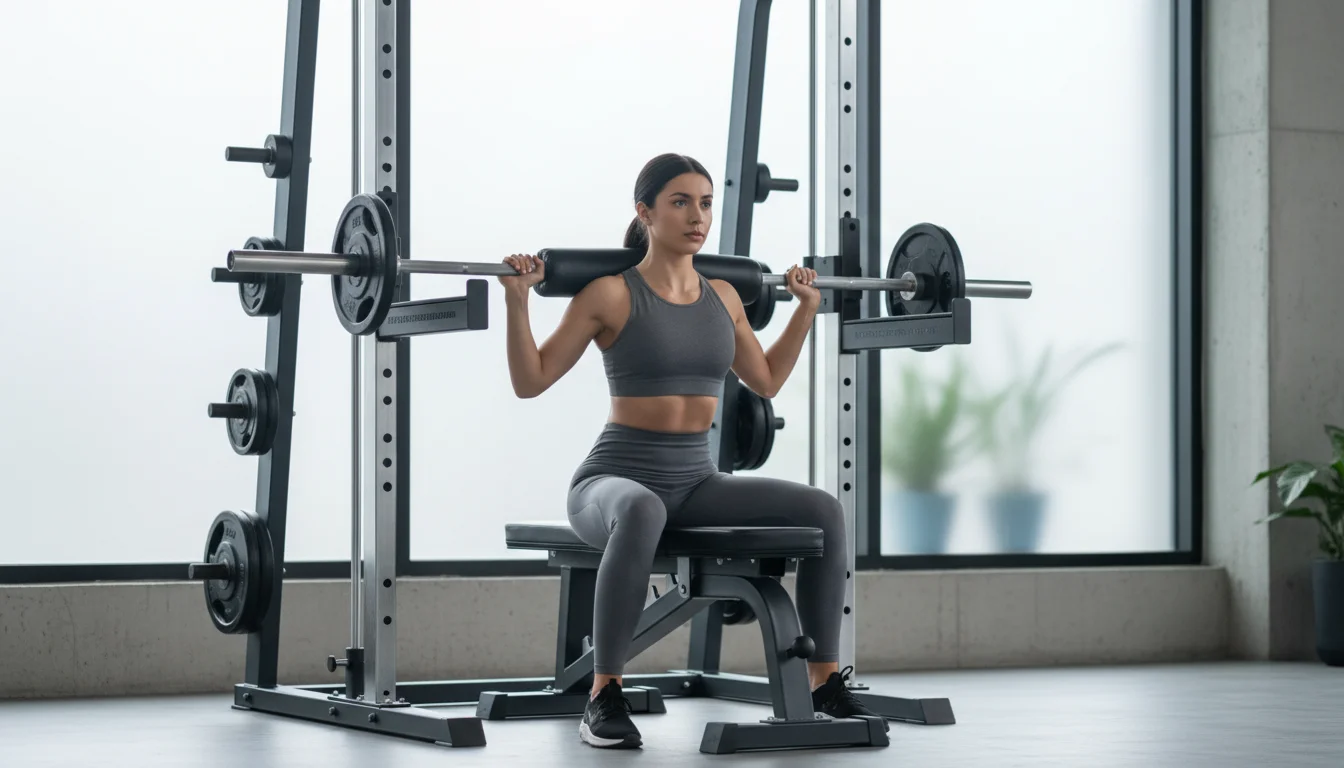
Why Choose the Smith Machine for Hip Thrusts?
The fixed bar path removes stabilization work from the equation, letting you direct all your mental energy toward squeezing your glutes at peak contraction.
Benefits of Smith Machine Hip Thrusts:- No balance required. The guided bar path helps beginners master the hip extension pattern faster
- Solo-friendly training. Lockable safety catches let you train to failure without a spotter
- Easier setup. Unracking and reracking takes seconds compared to wrestling a loaded barbell into position
- Better mind-muscle connection. Zero wobble means zero distraction from glute activation
| Variation | Stability Demand | Setup Difficulty | Failure Safety | Best For |
|---|
| Smith Machine | Low | Easy | High (safety catches) | Beginners, solo training, high-rep sets |
|---|---|---|---|---|
| Barbell | High | Moderate | Low | Experienced lifters, strength focus |
| Dumbbell | Moderate | Easy | Moderate | Home gyms, lighter loads |
For pure glute isolation, the Smith machine wins. For overall athletic development and stabilizer strength, the barbell has its place. Choose based on your goal for that session.
Equipment Setup: Bench Position and Bar Height
Position a flat bench perpendicular to the Smith machine so your upper back rests just below your shoulder blades when seated on the floor.
Hip thrust Smith machine setup checklist:- Bench placement: Upper back contacts the pad, shoulder blades align with the top edge
- Bar height: Low enough to roll over your hips while seated, high enough to clear your legs when lying back
- Hip protection: Wrap a barbell pad or thick folded towel around the bar
- Bench stability: Ensure the bench won't slide during heavy sets—push it against a wall or weight stack if needed
The bar should rest in your hip crease, not on your stomach or thighs. Too high causes discomfort and limits range of motion. Too low makes setup awkward and shifts loading away from your glutes.
I learned this the hard way. My first attempt had the bench too far from the bar, and I spent more energy wiggling into position than actually thrusting. Get the spacing right before adding weight.
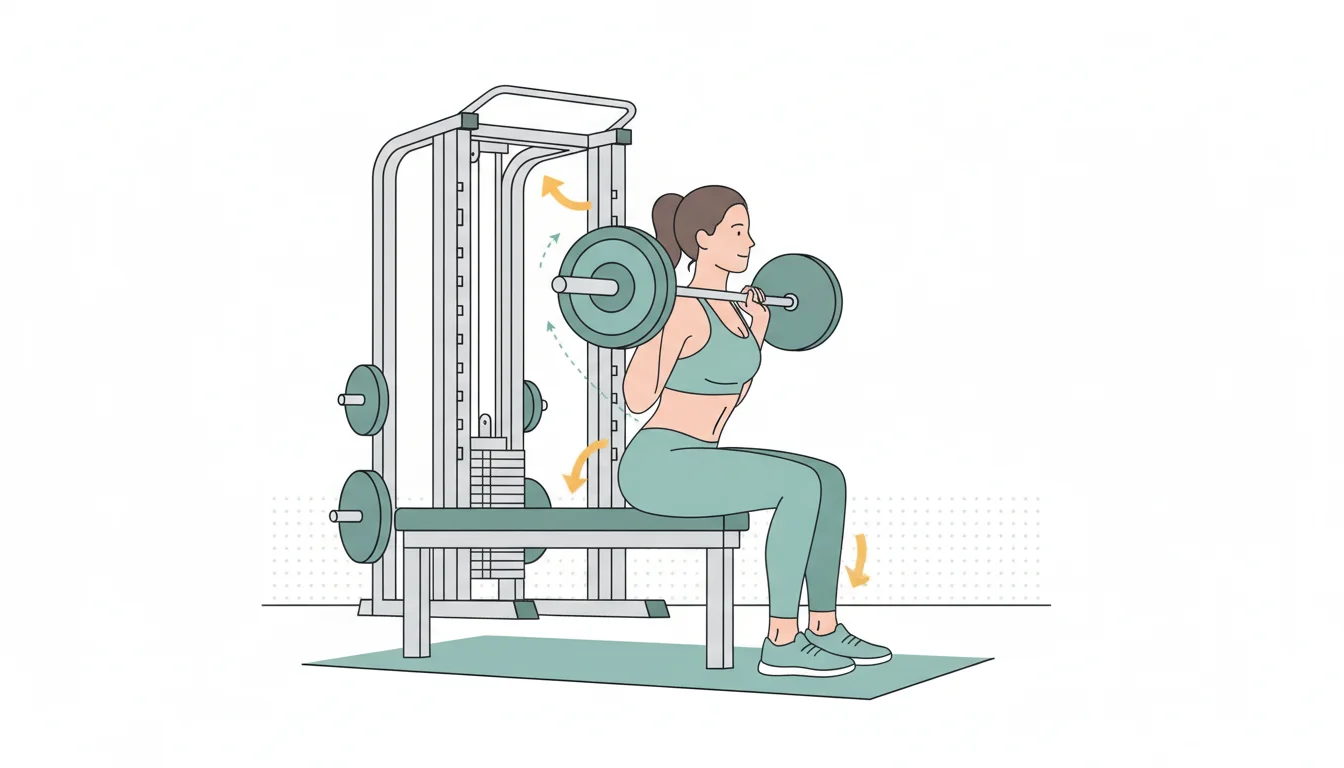
Optimal Foot Placement for Maximum Glute Activation
Place your feet hip-width apart with shins vertical at the top of the movement. This creates roughly a 90-degree knee angle at full hip extension.
Foot placement variables:- Width: Hip-width to slightly wider, based on your hip anatomy
- Toe angle: 10-30 degrees outward for natural alignment
- Distance from bench: Closer emphasizes glutes; further forward recruits more hamstring
- Heel elevation: A small plate under your heels can deepen glute contraction for some people
- Knee pain or excessive quad burn (feet too close)
- Hamstrings cramping or taking over (feet too far forward)
- Knees caving inward (stance too narrow or toes pointing too straight)
- Lower back strain (feet positioned incorrectly, breaking neutral spine)
Experiment during your warm-up sets. Move your feet an inch forward, then an inch back. You'll feel the difference in where the burn hits. The right position feels like your glutes do all the work while your hamstrings and quads stay relatively quiet.
Step-by-Step Execution: How to Perform the Movement
How to hip thrust on smith machine properly requires attention to body position, bar placement, and movement tempo throughout every rep. Starting position:1. Sit on the floor with your upper back against the bench pad
2. Roll or slide under the bar so it rests in your hip crease
3. Place feet flat, hip-width apart, with knees bent
4. Grip the bar slightly wider than shoulder width
The thrust:1. Tuck your chin toward your chest—eyes look forward, not up
2. Drive through your heels while pushing your hips toward the ceiling
3. Maintain posterior pelvic tilt by tucking your tailbone under throughout
4. Squeeze your glutes hard at the top and hold for 1-2 seconds
5. Lower with control until the bar nearly touches the floor
Breathing pattern:- Exhale forcefully as you thrust upward
- Inhale as you lower back down
The top position matters most. Your body should form a straight line from shoulders to knees. No sagging hips. No hyperextended lower back. Pure glute tension.
Fair warning: the 1-2 second hold at the top transforms this exercise. It's uncomfortable, and your glutes will burn. That's the point.
Common Mistakes and How to Fix Them
Most Smith machine hip thrust form errors stem from rushing reps or chasing weight before mastering the movement pattern.
| Mistake | What Happens | The Fix |
|---|
| Hyperextending lower back | Lumbar spine takes over, glutes disengage | Stop at neutral spine, squeeze glutes to finish the rep |
|---|---|---|
| Pushing through toes | Quads dominate, glutes underworked | Lift toes slightly, drive exclusively through heels |
| Bench too high | Reduced range of motion, awkward angle | Upper back should contact bench, not mid-back |
| No pause at top | Momentum carries the weight, less muscle tension | Hold peak contraction 1-2 seconds every rep |
| Knees caving in | Inefficient force transfer, potential injury | Push knees out slightly, consider a mini band above knees |
| Bar too high on body | Stomach discomfort, poor leverage | Reposition to hip crease, where thigh meets torso |
| Partial reps | Limited muscle development, false strength gains | Lower until bar nearly touches floor each rep |
The most common issue I see: people finish the rep with their lower back instead of their glutes. If your lower back feels pumped after hip thrusts, you're doing them wrong. Reset your form with lighter weight.
Progressive Overload and Programming Tips
Start with the empty bar or light weight to ingrain proper technique before chasing numbers.
Programming guidelines for Smith machine hip thrusts:- Frequency: 2-3 sessions per week for optimal glute development
- Progression: Add 5-10 lbs when you complete 12-15 clean reps with a pause at the top
- Rep ranges: Heavy days at 6-8 reps, hypertrophy focus at 10-12 reps, metabolic stress at 15-20 reps
- Tracking: Log weight, reps, and how the glute squeeze felt each session
Your glutes respond well to variety. Alternate between heavy low-rep days and lighter high-rep sessions. The pump from a 20-rep set hits differently than the grind of a heavy 6-rep set. Both build muscle.
Trust me—a 15-rep set with a 2-second hold at the top will humble you faster than throwing plates on the bar. Quality contractions beat ego lifting every time.
FAQ
How much weight should a beginner use for Smith machine hip thrusts?
Start with just the bar (typically 15-20 lbs on a Smith machine) or add 25-50 lbs total. Master the movement pattern and mind-muscle connection before adding significant weight. Form always comes first.
Are Smith machine hip thrusts as effective as barbell hip thrusts?
Both variations effectively target the glutes. The Smith machine isolates glutes better by removing stabilization demands, while the barbell builds more overall strength including stabilizer muscles. Neither is superior for everyone.
How do I know if I'm using my glutes and not my lower back?
Your glutes should feel the burn during the set and the pump afterward. If your lower back aches or feels worked, you're hyperextending at the top. Reset with lighter weight, focus on posterior pelvic tilt, and stop each rep at neutral spine.
Should I use a pad on the bar for hip thrusts?
Yes. A barbell pad or thick towel protects your hip bones from bruising and discomfort. This becomes essential as you increase weight, since discomfort limits your ability to push hard and focus on glute activation.
What's the difference between feet closer vs. further from the bench?
Feet closer to the bench emphasizes glute activation. Feet further forward increases hamstring involvement. Experiment with both positions to find what gives you the strongest glute contraction based on your individual anatomy.
Can I do hip thrusts on Smith machine every day?
No. Your glutes need 48-72 hours to recover between sessions. Training them 2-3 times per week allows adequate recovery while providing enough stimulus for growth. Daily training leads to diminished returns and potential overuse issues.
Why do my quads burn more than my glutes during hip thrusts?
You're likely pushing through your toes instead of your heels. Try lifting your toes slightly off the ground during the movement. Also check your foot distance—feet too close to your body shifts emphasis toward quads.