Do Smith Machine Squats Work Glutes? Science-Backed Answer & Form Guide
Do Smith Machine Squats Work Glutes? Science-Backed Answer & Form Guide
Smith machine squats activate the gluteus maximus effectively when you position your feet forward of the bar and squat to parallel depth or below. Research shows wider stances increase glute activation by 13% to 61% compared to narrow stances. This guide covers the biomechanics, optimal technique, and programming strategies for maximizing glute development with Smith machine squats.
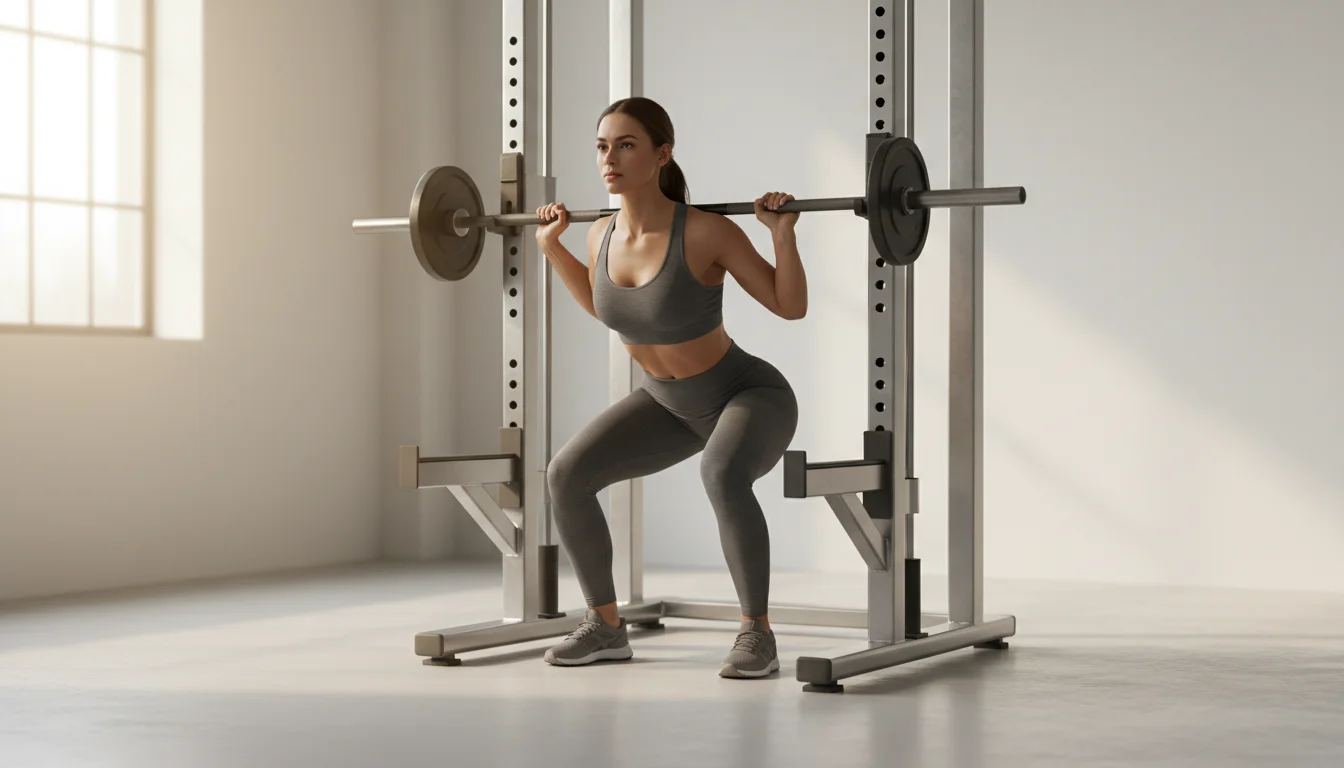
How Smith Machine Squats Activate Your Glutes
Do Smith machine squats work glutes? Yes. The fixed vertical bar path allows you to position your feet forward, increasing hip flexion angle and forcing your glutes to work harder during the ascent.| Factor | Smith Machine Squat | Free Weight Barbell Squat |
|---|
| Bar Path | Fixed vertical track | Free movement in all planes |
|---|---|---|
| Foot Position | Can place 6-12 inches forward | Must stay under bar for balance |
| Stabilizer Demand | Lower | Higher |
| Glute Isolation | Easier to target | Requires more coordination |
| Mind-Muscle Connection | Simpler to achieve | More challenging |
The ability to walk your feet forward changes everything. When your feet sit ahead of the bar, your hips must travel backward and down during descent, creating a larger hip flexion angle at the bottom position. Your gluteus maximus then works overtime to extend those hips as you stand back up.
EMG studies from [Frontiers in Sports and Active Living] confirm that Smith machine squats produce comparable glute activation to free weight variations. The reduced stabilizer demand lets you focus mental energy on squeezing your glutes through each rep.
Optimal Foot Placement and Stance for Maximum Glute Engagement
Position your feet 6 to 12 inches forward of the bar and adopt a shoulder-width or slightly wider stance with toes pointed outward 15 to 30 degrees.
| Stance Variable | Quad-Dominant Setup | Glute-Dominant Setup |
|---|
| Foot Position | Directly under bar | 6-12 inches forward |
|---|---|---|
| Stance Width | Narrow | Shoulder-width or wider |
| Toe Angle | Straight ahead | 15-30 degrees outward |
| Squat Depth | Above parallel | At or below parallel |
| Weight Distribution | Mid-foot to toes | Heels and mid-foot |
Depth matters significantly. Research from [NIH] shows gluteus maximus activity increases approximately 65% when moving from shallow to medium depth squats. Some studies report up to 25% more activation in deep squats compared to parallel.
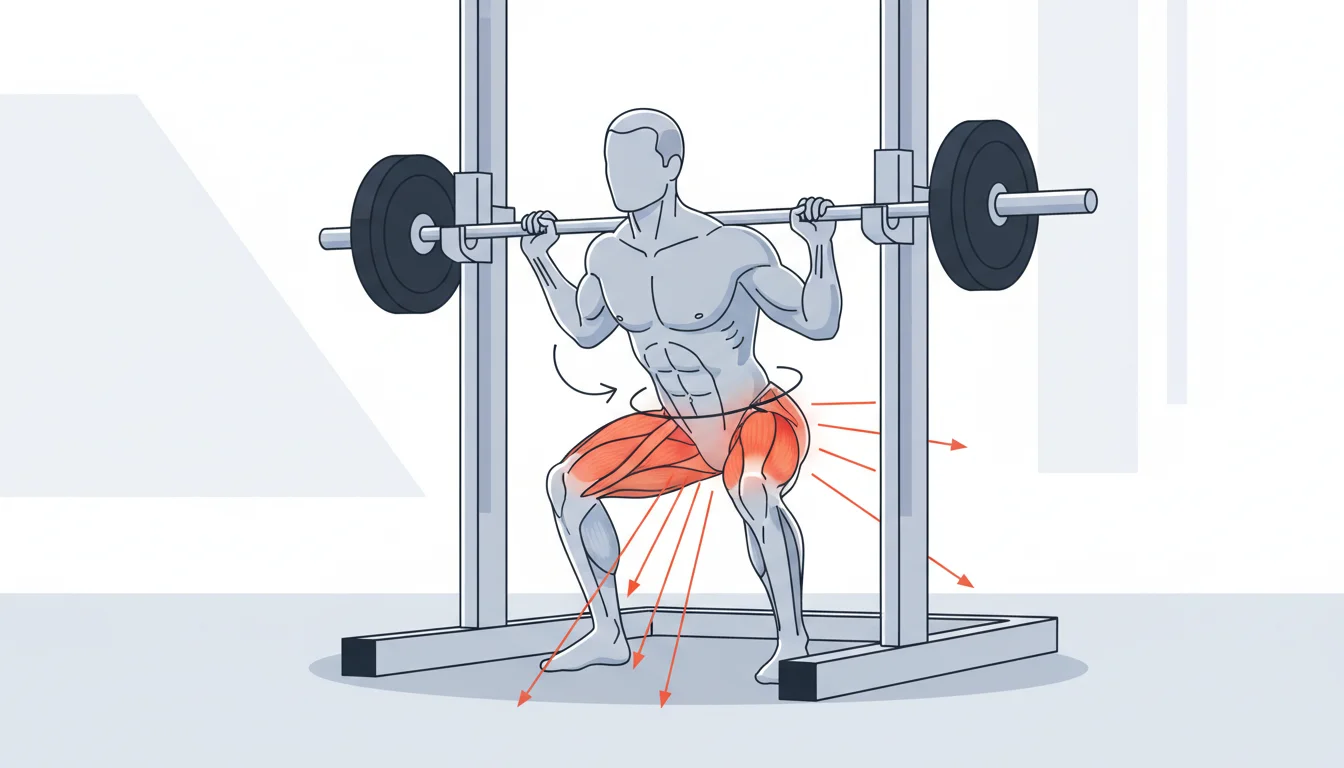
After testing different positions, here's what I learned: start with feet about 8 inches forward and adjust based on where you feel the burn. If your quads fatigue first, walk your feet further forward. If you feel unstable, bring them back slightly. The sweet spot is where your glutes scream before anything else.
Step-by-Step Form Guide for Glute-Focused Smith Machine Squats
Set the bar across your upper traps or rear deltoids, walk your feet forward to your preferred glute-targeting position, then unrack by rotating the bar hooks.
Setup Phase:- Position the bar at upper chest height on the Smith machine
- Duck under and place the bar across your upper traps (high bar) or rear delts (low bar)
- Grip the bar wider than shoulder width for stability
- Walk your feet forward 6 to 12 inches before unracking
- Initiate by pushing your hips back first
- Bend your knees after your hips begin moving
- Keep your chest lifted and core braced
- Descend until your thighs reach parallel or below
- Maintain weight on your heels and mid-foot throughout
- Drive through your heels to begin standing
- Squeeze your glutes actively as your hips extend
- Hold a hard glute contraction for 1 to 2 seconds at the top
- Reset your brace before the next rep
Breathing technique makes a noticeable difference. Inhale deeply before descending to create intra-abdominal pressure. Hold that breath through the bottom position. Exhale as you pass the sticking point on the way up. This bracing pattern protects your spine and helps you move more weight.
Fair warning: the first few sessions with feet forward feel awkward. Your body wants to keep feet under you. Trust the position. After three or four workouts, the movement pattern clicks.
Common Mistakes That Reduce Glute Activation
Keeping your feet directly under the bar shifts nearly all the work to your quadriceps and minimizes glute involvement.
- Feet positioned under bar: Your quads dominate. Move your feet forward 6 to 12 inches.
- Cutting depth short: Stopping above parallel leaves glute activation on the table. Go deeper.
- Knees caving inward: Push your knees out over your toes throughout the movement. Internal rotation reduces glute engagement.
- Rising onto toes: Weight shifting forward recruits quads and stresses knees. Drive through your heels.
- Ego loading: Too much weight forces shortened range of motion. Use weight you can control through full depth.
- Relaxing at lockout: Failing to squeeze your glutes at the top wastes the peak contraction opportunity.
Research from [NIH] indicates gluteus maximus activation during squats reaches up to 92.7% of maximal voluntary contraction when form stays correct. Poor technique cuts that number dramatically.
The mistake I see most often: people load heavy weight then barely bend their knees. A 135-pound squat to full depth builds more glute muscle than a 225-pound quarter squat. Check your ego at the rack.
Smith Machine vs Free Weight Squats: Which Is Better for Glutes?
Both variations build glutes effectively. Smith machines offer easier glute isolation, while free weights demand more total body coordination.
| Consideration | Smith Machine Advantage | Free Weight Advantage |
|---|
| Glute Isolation | Feet-forward position targets glutes directly | Requires precise technique for glute focus |
|---|---|---|
| Safety | Built-in catch points, no spotter needed | Requires spotter or safety bars |
| Stabilizer Work | Minimal | High |
| Functional Carryover | Lower | Higher |
| Learning Curve | Shorter | Longer |
| Mind-Muscle Connection | Easier to establish | More challenging |
The honest answer: use both. Smith machine squats work well as your primary glute-focused movement, while free weight squats build the stabilizers and coordination that transfer to athletic performance. A program containing both covers all bases.
I personally use Smith machine squats on days when I want to destroy my glutes without worrying about balance. Barbell squats happen on days focused on total lower body strength. This combination produces better results than either exercise alone.
Programming Smith Machine Squats for Glute Growth
Train Smith machine squats twice weekly using 3 to 4 sets of 8 to 12 repetitions with 2 to 3 minutes of rest between sets.
Weekly Programming Template:| Training Day | Sets x Reps | Tempo | Rest Period |
|---|
| Day 1 (Heavy) | 4 x 8 | 3-1-2 (3 sec down, 1 sec pause, 2 sec up) | 3 minutes |
|---|---|---|---|
| Day 2 (Volume) | 3 x 12 | 2-0-2 | 2 minutes |
Progressive overload drives glute growth. Add 5 pounds when you complete all prescribed reps with good form. If adding weight compromises depth, stay at the current weight until your strength catches up.
Tempo manipulation increases time under tension without adding load. A 3-second lowering phase followed by a 1-second pause at the bottom creates significant glute stimulus. Your muscles don't know how much weight sits on the bar—they only know tension and time.
Pair Smith machine squats with hip thrusts and Romanian deadlifts for complete glute development. The squat builds glutes through a stretched position. Hip thrusts maximize contraction at the top. Romanian deadlifts strengthen the hip hinge pattern. Together, they cover every angle.
FAQ
How far forward should feet be for glute-focused Smith machine squats?
Position your feet 6 to 12 inches ahead of the bar. Start at 8 inches and adjust based on where you feel the most glute activation during your working sets.
Do Smith machine squats build glute size or strength?
Both. The 8 to 12 rep range builds muscle size through hypertrophy, while lower rep ranges with heavier weight develop strength. Alternate between rep ranges for balanced development.
Are Smith machine squats safe for beginners?
Yes. The fixed bar path and built-in safety catches make Smith machines beginner-friendly. New lifters can focus on movement patterns without balancing concerns.
How deep should I squat for maximum glute activation?
Squat to at least parallel, where your thighs are horizontal. Going slightly below parallel increases glute fiber recruitment. Only go as deep as you can while maintaining a neutral spine.
Can Smith machine squats replace barbell squats entirely?
They can for glute-focused training. For overall athletic development and functional strength, include free weight squats in your program. Each variation offers unique benefits.
What weight should I start with on Smith machine squats?
Begin with just the bar to learn the feet-forward position. Add weight in 10-pound increments once your form feels solid through full range of motion.
Why do my quads burn more than my glutes during Smith machine squats?
Your feet are too far back. Walk them forward another 2 to 4 inches. Also check that you're driving through your heels rather than your toes during the ascent.
How long until I see glute growth from Smith machine squats?
Visible changes typically appear after 8 to 12 weeks of consistent training with progressive overload. Strength gains show up faster, usually within 3 to 4 weeks.